
The site for writers of all genre, and the readers who love them. Find what you want to know.
Synopsis
A synopsis, whether for fiction or nonfiction, is a concise summary of the main points, plot, or argument of a work, but their focus differs: fiction synopsis details the made-up narrative arc, characters, and ending (including spoilers) to show story progression, while nonfiction synopsis summarize factual events, information, or arguments to inform readers, often focusing on the book’s scope, core themes, and key takeaways rather than a fictional plot.
Fiction Synopsis
- Purpose: To outline the invented story, characters, conflicts, and resolutions.
- Content: Covers the entire narrative arc, including the ending, showing who changes and why.
- Style: Uses present tense (conventionally) and focuses on “what happens” in the story.
- Examples: Summaries for novels, short stories, plays, films (e.g., “Hamlet,” “To Kill a Mockingbird”).
Nonfiction Synopsis (or Summary)
- Purpose: To present factual information, arguments, or real-life accounts.
- Content: Summarizes the core thesis, key evidence, main events, or scope of the work (e.g., a biography, history, or essay).
- Style: Focuses on providing information and persuading the reader of the author’s points.
- Examples: Summaries for biographies, memoirs, textbooks, or historical accounts (e.g., Sapiens, The Diary of Anne Frank).
Key Difference
- Fiction: A summary of an imagined story, focusing on plot points and character development.
- Nonfiction: A summary of real events, facts, or ideas, focusing on informational content and argument.

Submission Tracking
Linda S. Dupie
Recently a writer asked me how I keep track of my submissions, this is something I hadn’t thought about often, but something I do day after day. There are as many ways to track your submissions, as there are writers, for simplicity we’ll look at three of the most common systems I have found while talking to writers. Some writers use their computers, others use index cards, notebooks, and some write the information on the files they keep for each project. Others use all of the above.

What Are Your Chances of Getting Published?
Laura Backes
Most beginning children’s writers are curious about their chances of ever seeing their work in print. Editors have told me that a mid- to large-sized publishing house gets upwards of 5000 unsolicited submissions a year. About 95% are rejected right off the bat (most get form letters, a few promising authors get personalized notes stating why the manuscript was rejected).

Conquering the Dreaded Synopsis: A Series of 10 Lectures
Lisa Gardner lectures to help with the dreaded synopsis. In her Writer’s Toolbox section of the website Lisa offers this great series of lectures (PDF) to help you with the dreaded synopsis.
This in-depth lecture series, developed from a month-long class, covers everything from understanding the publishing market to writing a short synopsis to putting together a complete submission package. If you’re serious about marketing your novel, this is a good place to start.

Writing a Synopsis & Query Letter
by Charlotte Dillon
I think this is probably one of my most popular pages. It doesn’t matter if you are submitting to an agent, a big New York publishing house, or a small press, you have to have a synopsis and a query letter to go with that manuscript. In fact, many of the big houses, and even some agents, will only accept a query and or a synopsis. Chapters can only be sent later if they ask to see them. Hopefully, the information you’ll find listed here will have you writing both like an old pro.

How to Write a Novel Synopsis
It’s probably the single most despised document you might be asked to prepare: the synopsis. The synopsis is sometimes required because an agent or publisher wants to see, from beginning to end, what happens in your story. Thus, the synopsis must convey a book’s entire narrative arc. It shows what happens and who changes, and it has to reveal the ending.
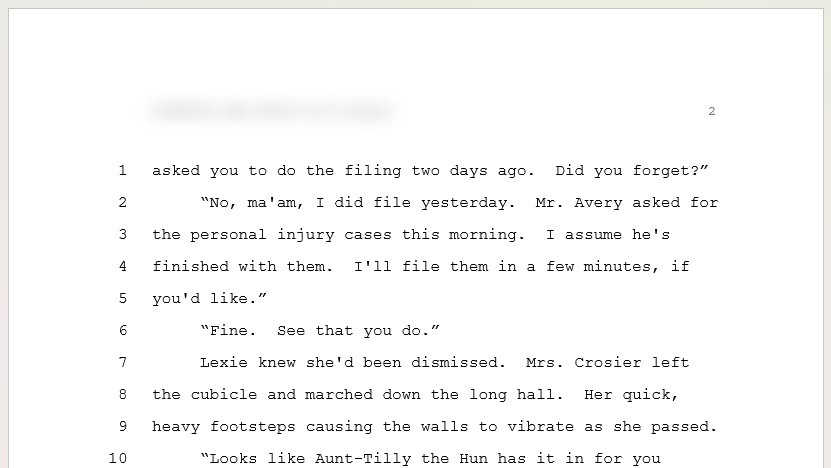
Achieving 250 Words / 25 Lines Per Page
So,, you’ve checked the publishers requirements and have no idea how to make your manuscript fit their requirements. Here is how to achieve the Ideal format for novel submission, 250 words per page, only 25 lines per page, what fonts to use and how to set up headers, footers and margins.
Subscribe

Author Ads
Business Ads
Business Ad