

The site for writers of all genre, and the readers who love them. Find what you want to know.
Publishing
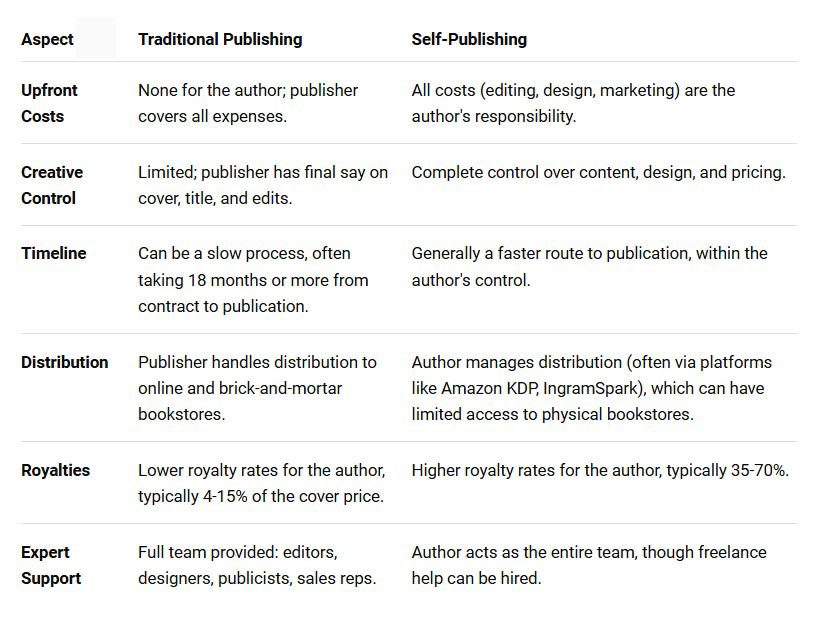
Book publishing is the process of making written content available to the public, involving stages like editing, design, production, marketing, and distribution. Authors can choose between two primary avenues: traditional publishing and self-publishing, each with distinct processes and levels of author control.
Traditional Publishing Process
In traditional publishing, a publishing house manages the entire process and assumes all financial risk in exchange for the rights to the book and a larger share of the royalties. The author typically needs an agent to secure a contract.
Write and Revise the Manuscript: The author completes a polished manuscript (for fiction) or a detailed book proposal with sample chapters (for non-fiction).
- Find a Literary Agent: The author queries agents who specialize in their genre. The agent acts as an intermediary, pitching the book to editors at publishing houses.
- Acquisition and Contract: A commissioning editor at a publishing house decides to acquire the book, and the agent negotiates a contract, including an advance against royalties and terms.
- Editing and Production: The publisher’s team handles developmental editing, copyediting, proofreading, cover design, and formatting.
- Sales and Marketing: The publisher’s sales team pitches the book to retailers (e.g., bookstores, online stores like Amazon) to secure orders, while the marketing and publicity teams run campaigns and arrange reviews.
- Distribution and Publication: The book is printed (or produced digitally) and distributed to warehouses and retailers. The book is then officially published and available for sale.
Self-Publishing Process
Self-publishing puts the author in control of the entire process, including costs, design, marketing, and distribution, while allowing them to retain all rights and a higher percentage of royalties.
- Write and Edit the Manuscript: The author writes and revises their manuscript, often hiring freelance professional editors for quality control.
- Design and Formatting: The author arranges for the book’s cover design and interior formatting for both print and e-book formats.
- Choose a Publishing Platform: The author selects a platform (e.g., Amazon Kindle Direct Publishing, IngramSpark, Barnes & Noble Press) to publish and distribute their book.
- Upload and Set Details: The author uploads the manuscript and cover files, sets the price, and provides metadata (title, description, keywords, categories).
- Marketing and Promotion: The author is responsible for creating and implementing a marketing strategy to reach their target audience and drive sales, using tools like social media, advertising, and author websites.
- Publication and Sales: The author publishes the book on their chosen platforms and monitors sales and reviews, receiving higher royalties per sale than in traditional publishing.
Key Differences at a Glance

Syndication 101
How to get your foot in the door without getting it stepped on.
By Perucci Ferraiuolo
It has long been held that an editor is a man or woman who knows exactly what he or she wants, but doesn’t know what it is. Never is it more true than within the syndication marketplace. And, I’ve found that most editors know what they want based on what they DON’T want. In other words, they know the “junk” and are only looking for the “treasure.”

Science & Science Fiction Writing Organizations
A growing list of Science and Science Fiction Writing Associations – Great for Publishing information or a resource for your mauscript.

Path to Self-Publishing Success
Bob Baker
When the subject of e-publishing and self-publishing on the Internet comes up, the conversation usually turns to talk of .pdf and .exe files, not to mention the pros and cons of various personal ebook readers. What you don’t hear much about is the workhorse of Internet communication: basic e-mail.
Navigating In Your Novel
Susan Gillett Domokos
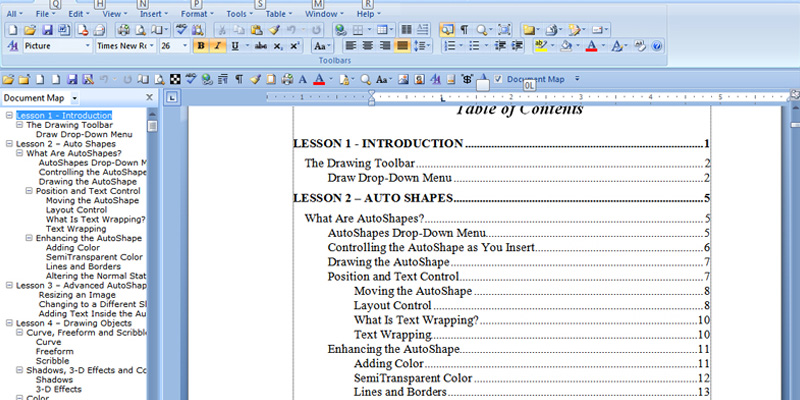
You’re sitting in your chair, estranged from the rest of the household. (Not because you can’t stand the normal noise of your family, i.e. bellowing partner, screaming kids, blaring television, etc., but because they can’t stand the oddly vacant, zombie-like look that pervades your face every time you sit down to prove to the world that you’re a literary genius, and have therefore shoved you off into a nicely made up broom closet, with a single yellowed bulb swaying gently above your head, to be CREATIVE… (Using the Document Map)

Tightening Your Manuscript and Trimming the Word Count
Deanna Lilly
Now that the mechanics of achieving 250 words and 25 lines per page are out of the way, the manuscript is complete and perfect (you didn’t forget to remove the line numbers before printing and sending your “baby” to your editor) and at last the wait is over. Finally, you get the long awaited letter back. Your editor has fallen in love with your story BUT, she/he wants you to cut your 100,000-page masterpiece to 90,000 pages.

Rules for Writers
PPW (Panhandle Plains Writers) Amarillo, Texas
A cheeky set of incorrect grammar usage to help you learn and laugh.

Agents: Knowing When To Hold One and When To Fold
Shirley Kawa-Jump
Agents can be a wonderful thing, IF they are working for you and with you. I have negotiated deals with agents, without agents, and have fired agents who didn’t seem to be on the same page as I was. Overall, I believe having an agent makes things happen faster, but they are certainly no guarantee for success.

Getting Offers from Multiple Literary Agents
Mary Kole
Every writer dreams of getting offers from multiple literary agents, right? Maybe. A reader asked about what a writer should do if they happen to get offers of representation from multiple agents. First of all, congratulations are in order. An offer of representation is professional validation to a writer who has, most likely, not really gotten such praise and confidence from an expert source.

Making Money As a Corporate Freelancer
Shirley Jump
One of the fastest-growing and most-lucrative areas for writing is corporate writing. If you have some understanding of marketing, a flair for words and an ability to meet short deadlines, this is a great area to consider.
Subscribe

Author Ads
Business Ads
Business Ad