

The site for writers of all genre, and the readers who love them. Find what you want to know.
Dumb Little Writing Tricks That Work

20 writing tips which actually are quite smart… because they work.
by Scott Myers
Over the years, I’ve come up with or stumbled upon a number of tricks to help with the writing process. Here are some of them. In addition to his work as a screenwriter and educator, Myers has written extensively on the craft of screenwriting. His book “The Screenwriter’s Bible: A Complete Guide to Writing, Formatting, and Selling Your Script” is a widely recognized resource in the field. He also regularly shares insights and advice for screenwriters on his blog, Go Into The Story.
Scott Myers is a respected figure in the screenwriting community, known for his contributions to the field and his dedication to helping aspiring screenwriters improve their craft
01. One Page A Day
I heard this idea from producer Larry Gordon about how to knock out a script: Write one page per day. Think about it — at one page per day, in 4 months you’ve generated a 120 pages. So if you take this approach:
- 1 month: Research, brainstorming, character development, plotting
- 4 months: Writing (1 page per day)
- 1 month: Rewrite and final edit
Which means you can crank out 2 full-length screenplays per year — by writing just one page per day.
02. Adopt a Different Writing Persona
We value creativity and are often justifiably proud of our most creative acts. Solving a difficult problem at work is a major achievement. Writing a song or creating a novel work of art is an amazing feat. If you wander the aisles of your local bookstore, you find lots of books that promise to unleash your inner creative genius.
So, when a research finding comes along that suggests an easy way to improve your creativity, you should sit up and listen.
A paper by Evan Polman and Kyle Emich in the April 2011 issue of Personality and Social Psychology Bulletin provides just this kind of straightforward demonstration.
One of the factors that often prevents people from doing something really creative is their existing knowledge. If you are writing a song, it is hard to come up with something that is very different from what other people have written, because you are reminded of melodies that you have heard before. If you are solving a problem at work, there is a tendency to focus on solutions that people have used in the past to solve similar problems.
So how do you break away…
03. Create an Argument
Let’s say you’re stuck writing a flat scene. No matter how you’ve approached it, the scene just lays there.
No energy.
No zip.
No nothing.
Do what producer Larry Gordon told me: Create an argument.
Get your characters screaming at each other. That ought to put some heat into the scene.
For example, you’ve got a scene with a lot of exposition in it. Exposition scenes are notorious for being hard to handle because…
Well, you’ve got a lot of exposition to deal with.
Since exposition is largely facts and information… and facts and information are largely devoid of anything resembling excitement…
You’re pretty much looking at the cause of a flat scene. Like this:
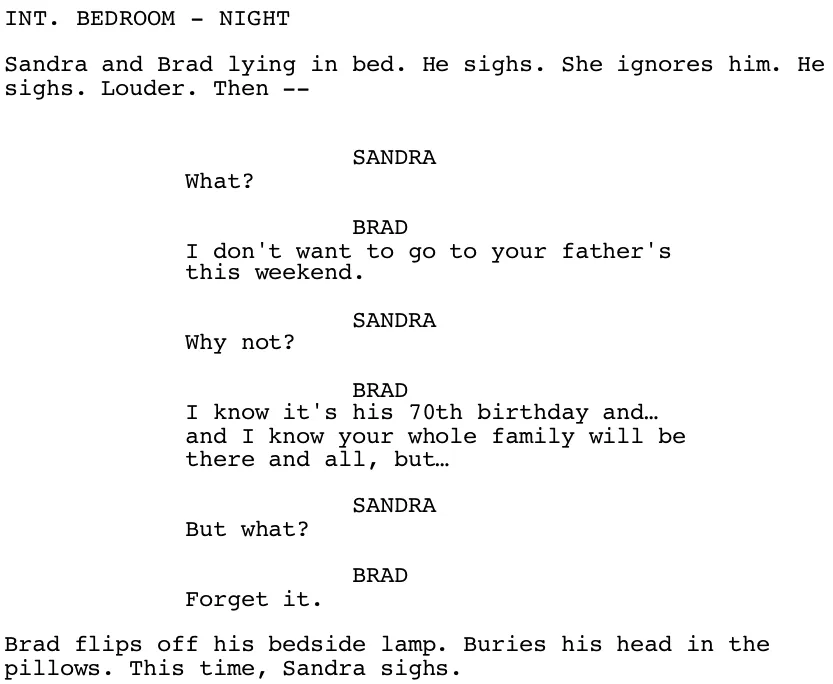
Okay, the scene did get out some exposition: Sandra’s father’s 70th birthday is coming up. There’s going to be a party. Her family will be there. And Brad doesn’t want to go. But it’s not terribly entertaining, indeed, it’s basically a flat scene. Now what if we created an argument?
04. Don't Finish That Scene
Let’s say you’re in the middle of writing a script — and it’s a slog. You’re finding it really tough to drag your ass onto the chair and start writing the next scene.
Well, let’s roll back the clock. What if yesterday, you hadn’t finished the previous scene? What if you got halfway through that scene, knew exactly where it needed to go to reach the end, but instead of completing it, you quit your writing session with the scene unfinished.
Get Scott Myers’s stories in your inbox
Join Medium for free to get updates from this writer.
Enter your email
Subscribe
Now instead of starting the next day having to break a new scene, you have the easy task of finishing the scene from the day before.
Bada-bing, bada-boom, you knock out the ending to the scene, giving your mind and your fingers a chance to warm up — and now you’re ready to charge ahead.
The trick is to stop in the middle of a scene. That way you can start the next day with the positive experience of finishing a scene and jump start the new writing session.
This has been another installment in the series “Dumb Little Writing Tricks That Work.”
For more, go here.
05. Free Association
What happens? In my experience, oftentimes I’ll hit on a nugget. Perhaps something related to the scene, perhaps not, maybe something later in the story, or an idea for something else entirely. Generally when that happens, I end my free association session. Other times, nothing seems to emerge, so I just stop.
Now when you open your eyes, you have a choice. The obvious one is to look at what you’ve typed. Maybe a line of dialogue there. A good visual. Perhaps you mistyped something, but that misspelling causes you to think of something that can help you.
There’s another choice: Print out what you’ve typed, fold it, stick it in an envelope, and seal it without looking at it. In one of a series of lectures writer David Milch gave some years back at the WGA Theater, he recommended this strategy. It struck as some kind of weird voodoo shaman shit, but a few months later, I actually tried it — three days running to start my writing sessions. I’m not sure what Milch’s intent was — probably just to get the writer away from prejudging what they’ve written — but I will say that (A) I looked forward to doing it, which helped to get me to my writing sooner, (B) I did generate some ancillary ideas which I recorded in another Word brainstorming file, and (C) it rattled my cage and made the next several days a fresher, more fun experience.
Whatever you do or however you do it, the point is to let your mind roam and see what emerges. Could be nothing. Or could be the key to unlock your problem scene.
For my 5-part series featuring videos and transcripts of David Milch’s legendary 2001 and 2007 WGA presentations, go here.
06. Get Off Your Ass
There’s a saying attributed to Oliver Stone: “Writing equals butt on chair.”
And for the most part, he’s right. What writers do… a helluva lot of what we do derives from sitting on our ass.
Sitting.
Typing.
Sitting.
Thinking.
Sitting.
Stressing.
Sitting.
Sitting.
Sitting…
Let’s say you’re at your writing station… sitting. And you’re stuck.
A scene isn’t working.
A character just told you to shove off.
A major subplot just collapsed and the tumbling debris crushed your psyche.
You can sit for the next several hours, bashing your forehead against the computer. Or you can…
Get.
Off.
Your.
Ass.
Go for a walk.
Sprint up the sidewalk.
Do some jumping jacks.
Dance to loud music.
Shadow box.
Rip off your clothes and race around screaming in circles in your office.
07. Get Un-Comfortable
If your writing is feeling stale, here’s an idea: Rattle your own cage!
As background to this trick, consider what screenwriter Alvin Sargent suggests:
“You must write everyday. Free yourself. Free association. An hour alone a day. Blind writing. Write in the dark. Don’t think about what it is you’re writing. Just put a piece of paper in the typewriter, take your clothes off and go! No destination… pay it no attention… it’s pure unconscious exercise. Pages of it. Keep it up until embarrassment disappears. Eliminate resistance. Look at it in the morning. Amazing sometimes. Most of it won’t make any sense. But there’ll always be a small kernel of truth that relates to what you’re working on at the time. You won’t even know you created it. It will appear, and it is yours. Pure gold, a product of that pure part of you that does not know how to resist.”
Okay, when an Academy Award-winning screenwriter advises you to “take of your clothes and go,” that makes me feel more comfortable sharing this trick with you:
“Get un-comfortable.”
- Take your laptop outside and write in the freezing cold.
- Start writing the instant you wake up. Don’t eat, don’t brush your teeth, don’t shower, don’t even pee — go straight to your writing station…
- Create an account to read the full story.
08. Highlight Your Verbs
I featured this bit of wisdom from screenwriter Larry Ferguson before here, the key quote being:
“There was a girl who came to me with her first screenplay. It was a good first shot. I gave her some advice. I told her, ‘I want you to go home and take a yellow Marks-A-Lot and highlight every verb in this 120-page screenplay, and then I want you to read them out loud and ask yourself, Can I find a stronger verb.’”
Movies are primarily a visual medium — and strong verbs convey more action and flavor than weak verbs.
Here are two verbs I see overused by writers: walk and look.
Instead of “He walks into the room,” choose one from this list:
stumbles, staggers, shoulders, ambles, meanders, shuffles, bounds, careens, trips, plunges, dives, blasts, thunders, tiptoes, inches, edges
Instead of “He looks at her,” why not one of these:
ogles, glares, stares, gapes, squints, locks on, fixes on, gawks, leers, peers, gazes, eyes, focuses on, scowls, glowers
Also see:
The second edition of the Oxford English Dictionary contains 171,476 words, thousands of them great verbs. Use them in your screenplay to enhance its visuality.
09. Listen To A Movie
Let’s say you have a moment of clarity. You admit to yourself that your ability to write dialogue could use a boost.
I’ve run across a lot of tricks re writing dialogue, but this is one of the best. Here’s what you do:
Step 1: Select a movie that is known for its stellar dialogue
Step 2: Find that movie (streaming, pay cable, DVD)
Step 3: Turn on your TV
Step 4: Turn your chair around so it’s facing away from the screen
Step 5: Deposit your butt onto the chair
Step 6: Listen to the movie
That’s right. Do not watch the movie. Listen to it. And if you’re still confused by my advice, let me make this very clear:
I am asking you to sit in a room… with your back to the TV… looking like a complete fool… then listen to the movie.
If you can get past the whole “complete fool” thing, you can learn a lot.
In particular, you are listening to…
the length and shape of each side of dialogue…
the collection of those exact words into those sides of dialogue…
the pacing of the language in the movie…
the emotion behind each word…
phrases that grab your attention.
If you really want to benefit from this exercise as you hear each side of dialogue, imagine what that side looks like in screenplay form.
When I’ve done this in the past, I imagined the words being typed out in my head as they were spoken by each character. I could even see how the page of dialogue laid out in my imagination.
One thing in particular to pay attention to is how does each character sound different? Not their voices, but the combination of the words they use, their word choices… slang, lingo, cadence, formality vs. informality.
The point is you’re trying to immerse yourself in the words spoken by the characters, the world of dialogue.
If you do this several times with different types of movie genres, I’ll bet you’ll have a kind of gestalt experience, where you suddenly grok dialogue in a way you’ve never gotten it before. That knowledge may be more instinctual than conscious, but I’d be hugely surprised if the next time you sat down to write, you would have a whole new level of understanding about writing the words that your characters speak.
And here is a bonus YOU get from reading all the way to the end of this post. If you go here, you can access 100s of audio version of movies. It’s called Listen To A Movie: For the Cubicle Workers of the World. Now you don’t even have to turn your chair around to listen to a movie. Just plug in your headphones using this website.
10. Make a Collage
Remember your first day in third grade? And your teacher… you know, the new one fresh out of college with boundless enthusiasm and alternative ideas about education… announced that instead of writing the same old dreary “What I Did Last Summer” paper, your homework assignment would be to do a collage. You had no idea what a collage was, so you ventured over to the big ass dictionary she had placed on that desk in the back of the room. There you read this definition:
a technique of composing a work of art by pasting on a single surface various materials not normally associated with one another, as newspaper clippings, parts of photographs, theater tickets, and fragments of an envelope.
And you came up with something like this:

While your collage may have faded into history, I’m resurrecting the idea for you in terms of your writing. Because if you’re feeling disconnected from your story and especially can’t get a vibrant sense of who your core characters are, having a hard time making them come ‘alive’ in your imagination, doing a collage could be just the trick to jump start your creativity.
The process is pretty simple. You scoop up all your magazines, newspapers, and catalogues into a big pile, then while keeping your story and/or characters in mind, you flip through the…
11. Name That Tune
Recently, I posted a DLWTTW suggesting the value of ‘star-casting’:
…that reminded me of “star-casting,” where a writer imagines ‘casts’ certain actors to ‘play’ the roles of various characters in the screenplay they are writing.
In comments, Désirée said:
Stupid advice, I would say. Then I just see the actor in roles she or he already played, and make my character as an already existing one.
As I’m prone to say, “There’s no right way to write.” Some writers may benefit from star-casting. Others… not so much.
So allow me to provide an alternate approach that won’t attach you to a specific actor: Figure out what song the character is.
I read this years ago, where a director on a film project approached all of the main actors and gave them each a song to consider in relation to their search to find their character’s essence.
I was reminded of this recently when I watched The Social Network. I won’t give away the plot, but there is a moment in the movie where the soundtrack kicks in with The Beatles’ song “Baby, You’re A Rich Man.”
12. Plot Backwards
You’re doing prep work, breaking the story. Problem is, the story is breaking YOU! The plot is a mess, you can’t figure it out, bits and pieces here and there, no flow, no coherent structure, just a bunch of scenes.
Quick question: Do you know your ending? Not the Denouement, but the Final Struggle, the climax of the story?
You do, you say? Well, good news, my friend, ‘coz I’ve got a dumb idea that just might work for you.
Start at the end and work your way backward.
Again, you KNOW the ending. So what scene comes BEFORE that?
And what scene comes BEFORE that?
And what scene comes…
You get the picture.
It’s a way of reverse engineering your story, switching cause-and-effect, so it’s effect, then cause… effect, then cause.
So if you’re stuck in the plotting process and aren’t moving forward…
Go BACKWARD!
Start at the end… and end at the beginning!
13. Read Your Dialogue Outloud
This is truly one of the easiest things you can do to improve your dialogue writing: When you finish a draft of your script, read aloud each character’s dialogue, all of their sides back to back to back.
Things to check for:
- Does each line work? Does it sound ‘real’ when you read it aloud?
- Repetitive lines
- Catch phrases a character might use
- The cadence of a specific character’s talking style
- Track the rhythm and pace of each side per what’s going on in each scene (i.e., they should match up)
Overall, one big thing you’re checking to see is if each of your characters has a distinguishable manner of talking. Plus, if YOU stumble over a particular side of dialogue, chances are an ACTOR will, too. Time. To. Edit.
It makes so much sense to do this, what’s so dumb about it? You. Standing in a room. Alone. Reading aloud. It’s awkward at first. But once you get used to it, it becomes a necessity with every script you read.
By the way, both Final Draft and Fade In allow you to print out an individual character’s sides of dialogue consecutively.
Up your dialogue-writing chops. Read your dialogue aloud!
14. Set A Deadline
Nothing like the fear of being publicly humiliated to motivate you to write.
There are a lot of find things to motivate a writer to write.
- The desire to craft a wonderful story…
- The fantasy of writing a million dollar spec script…
- The realization of putting on paper the singular story your life has led you to tell.
And then there’s possibly the best motivator of all… humiliation. Or the threat thereof.
If you can orchestrate events so that the fear of being humiliated by not writing is greater than the fear of having people read what you do write, then you will be well on your way to getting your ass in chair and plowing ahead to FADE OUT.
So how to ensure this threat of humiliation?
Set a deadline. Not just any deadline. A public deadline!
Prepare an email in which you state your goal — “I am going to finish a draft of my long cherished screenplay ‘Leopard Lips’” — and most importantly, you select and include a due date. To up the stakes, you can add something like, “And if I don’t produce a draft of ‘Leopard Lips’ by [due date], I hereby proclaim…
15. Snacks
It’s like maybe fifteen years ago and I’m reading an interview with noted playwright and screenwriter Neil Simon. And in this interview, Simon confesses that one way he forces himself to write is the judicious use of snacks. That’s right. Snacks. I don’t have the interview, but basically what I remember is that he’d get like a bag of Fritos, put them in a drawer across the room , sit down at his desk to write, look at the clock, and say to himself, “Okay, I’m going to write for thirty minutes, then I will allow myself a handful of Fritos.” And he’d write. Then get the Fritos. Sit back down then, “Awright, this time I’m going to write for forty-five minutes.” Forty-five minutes later, more Fritos. In essence, Simon had trained himself Pavlovian style to write, your basic behavioral psychology.
Do some of you use this type of enticement to lure you to write? If not, why not give it a shot? Pick out some snack that you really love. Sit your butt on chair, write for an hour, then give yourself a treat. Fritos, ahoy!
16. Star Casting
Having trouble writing a character? Cast an actor for the role.
The Variety report of the spec script sale yesterday — “Sunny and 68” — had this bit of business:
O’Connor, whose “Pride and Glory” was released this past weekend by Warner Bros., said he and Tambakis wrote the script, a drama with comedic overtones, with [Vince] Vaughn in mind for the lead character.
That reminded me of “star-casting,” where a writer imagines ‘casts’ certain actors to ‘play’ the roles of various characters in the screenplay they are writing. Set aside being lucky enough to have Vince Vaughn (or whoever you cast) agree to star in your movie — although “Sunny and 68” proves it can happen. A more tangible benefit?
If you’re having trouble focusing a character, envisioning an actor in the role can help you do just that.
When you write a spec script, you are making your own ‘movie.’ You can do anything you want. Why not cast Mark Wahlberg, Johnny Deep, Elizabeth Banks, Dakota Fanning (all currently in IMDb’s Starmeter Top 20)? Not only give more flavor and shape to your characters, but also make it more fun to write.
17. The Six Word Test
If you’re having trouble finding the focus of your story, try this test.
This all started with a bromide from Max Millimeter: Hollywood Movie Producer Extraordinaire about his approach to loglines:
That’s why I have the six-word rule. You got six words… count ‘em… one, two, three, four, five, six… six words in your logline to get my attention. If six words in your logline don’t come right at me, high and hard, and knock me on my keister, then you ain’t getting my attention. And your story? That’s a big fat Pasadena.
Then when I did an interview with screenwriter Daniel Kunka, he recounted how he came up with the idea for “Agent Ox,” a spec script he wrote which ending up selling to Sony Pictures:
I made a document called “High Concept Story Ideas” and just brain dumped a bunch of stuff down for two or three days, and the very last idea in this document were the six words “Human Spy on an Alien Planet” and I knew that was it.
I always joke in meetings now that those were the six words that changed my career and how I think about writing screenplays, but it’s the absolute truth…
If you want to write at a studio level, you must be able to communicate big ideas in simple terms. That’s how specs climb the food chain. If an…
18. Transcribe Screenplays
If it worked for Johann Sebastian Bach and F. Scott Fitzgerald…
Perhaps you’ve heard stories about how a young Felix Mendelssohn transcribed note for note musical scores by Johann Sebastian Bach, just to get the feel of how Bach wrote music.
Or about how F. Scott Fitzgerald transcribed the novels of writers he admired such as Charles Dickens to get the feel of their writing.
Why not do the same thing with screenplays?
If you’re struggling with any of the following:
- How to handle scene description
- How to manage transitions between scenes
- How to balance action and dialogue within scenes
- How much scene description is too much / too little
- How to write realistic dialogue
- How to use Scene Headings and Shots
- How to write a series of scenes, series of shots, and montage
You can read screenplays. But what about typing them — word for word?
An anecdote. In my quest to accumulate screenplays of my favorite movies, some years ago I commented in one of my screenwriting classes that I couldn’t find a script online for To Kill a Mockingbird.
Some months later, I received a PDF of the script via email. One of my students had purchased a hard copy of the script, then typed it up word for word in Final Draft, made a PDF of it, and sent it to me. And here’s the thing: She had quite positive comments about the transcription process, noting she felt like she understood the story much better than before having typed it out word for word.
Quite a learning experience!
Besides if it worked for Mendelssohn and Fitzgerald, don’t you think it could work for you, too?
19. Unplug Your Internet
And if you don’t have the self-control to do it, I’ve got a tip for you!
Press enter or click to view image in full size
An observation from writer and essayist Jonathan Franzen:
It’s doubtful that anyone with an internet connection at his workplace is writing good fiction.
Oh, yes. The evil temptress known as the Web! Sure, you should buckle down and get started on that scene. You know, the one you’ve been struggling with now for a couple of days. You know the only solution is likely just slogging your way through it time after time until you get it right. So here you go, opening the file. And there it is, the vexing scene itself. And here are your hands on the keyboard, ready to go, and then…
Fingers…
Wandering…
Over…
To…
The…
Mouse.
Open Internet browser.
And suddenly, it’s two-and-a-half hours later, where you find yourself bidding on eBay for a glow-in-the-dark Michael Jackson prayer shawl or some such nonsense that you have absolutely no need for… other than to distract you from your writing.
So here’s the trick: Stay offline. I mean literally unplug your DSL line. If you’ve got wireless, disable it. Don’t tell me you don’t know how to do that. I’m the world’s dumbest computer person and even I know how to disable my wireless.
Or try a program like Freedom.
Freedom users report gaining an average of 2.5 hours of productive time each day. We’re proud to have helped our users reclaim 10,000,000 hours in the past year. No wonder Freedom is used by people at the world’s best companies and universities.
And then just write.
Facebook will wait for you. The DailyKos will wait for you. Twitter won’t wait for you, but writing requires some sacrifice… even refraining from tweets.
What won’t wait is the solution to that damn scene!
So when you sit down to write, admit that while you may be a grown-up, at least in terms of your age, you really need to treat yourself like a child — and just unplug your Internet.
20. What to Do After You Finish Your First Draft
It may seem like a really dumb idea, but it’s a crucial step in rewrite process.
Okay, so you’ve just typed FADE OUT of the first draft of your latest screenplay. What’s the first thing you do?
Celebrate and get drunk? No, that’s the second thing you do.
The first thing you do is print out a copy of your script, stick it in a drawer, and don’t read it for two full weeks.
That’s right. Do not read it. For. Two. Full. Weeks.
“Why,” you may ask.
Because you have this thing known as a “rewrite” coming up. And one asset you will absolutely need for that process is a fresh set of eyes.
More than likely, at the moment you typed FADE OUT, your estimation of your first draft would put it (quality-wise) somewhere between Gone With the Wind and Juno. If you use that set of eyes to make judgments during your rewrite, you won’t improve your script much.
But if you give yourself two weeks off, 14 entire days without so much as peeking at your script, on day 15 when you finally do pull the script out of its drawer and read it, you will be amazed at what you find…
And that’s the point: The only way you can improve your script in the rewrite process is to identify and solve its problems. And you can’t solve the problems if you can’t ‘see’ them in the first place. And you can’t see them if you don’t have a fresh set of eyes.
By taking two weeks away from your script, you play a little trick on your brain, providing some distance between it and the script, resulting in a fresh set of eyes in order to honestly judge the material you’ve written.
Once again, here’s the trick:
- Type FADE OUT
- Print script
- Stash in drawer
- Set timer for 2 weeks
- On Day 15, pull script out of hiding, read, and begin your rewrite process
Now you’ll not only see the parts of your script which work, you’ll also be able to discern more clearly the parts of which need work.
AGENTS & EDITORS
- Agents: Knowing When To Hold One and When To Fold
- Copyright Primer, Know Your Rights
- Getting Offers from Multiple Literary Agents
- Landing An Agent Elements Of A Winning Query
- Literary Agents List
- Preditors and Editors
- Publishing, Writing Terms, Acronyms
- Tips for a Successful Editor Appointment
- Want More? Here’s How to Get It
- What NOT to Do When Beginning Your Novel
- Windup for the (Story) Pitch
CALLS FOR SUBMISSIONS

CALLS FOR SUBMISSIONS MAIN PAGE
- 2026 APR Calls for Submissions
- 2026 MAR Calls for Submissions
- 2026 FEB Calls for Submissions
- 2026 JAN Calls for Submissions
- 2025 DEC Calls for Submissions
- 2025 NOV Calls for Submissions
- 2025 OCT Calls for Submissions
- 2025 SEP Calls for Submission
- 2025 AUG Calls for Submission
- 2025 JUL Calls for Submission
- 2025 JUN Calls for Submission
- 2025 MAY Calls for Submission
COMPUTER TIPS
- ASCII Characters
- Building Your Web Site and Doing It Right
- Don’t Be a Victim-Scams, Identity Theft, Urban Legends
- Don’t Spread Scams
- Free AI Tools That Can Be Used In Business Writing
- How to Annoy Your Website Visitors
- If Your Data Is Compromised
- Internet Safety: Guide to Keep Your Information Safe Online
- Knowing Your Target Audience
- Online Safety for Kids and Teens
- Stopping Viruses from Propagating Through Your Email
- The Top 10 Email Errors
- Word Processors Through Time: Before MS Word & Google Docs
GRAMMAR & FORMATTING
GRAMMAR & FORMATTING MAIN PAGE
- Achieving 250 Words / 25 Lines Per Page
- And Sammy, Too? Oh, No!
- Changing Double Hyphens to EM Dashes in Word
- Edit Easier
- High Hopes–Avoiding Common Mistakes
- Misused Words
- Navigating In Your Novel
- Proofreaders Marks
- Research Links
- Rules for Writers
- Slang and Jargon Souces
- Tightening Your Manuscript and Trimming the Word Count
INSPIRATION-& MOTIVATION
INSPIRATION & MOTIVATION MAIN PAGE
- A Dream Realized
- Beyond the Basics
- Dumb Little Writing Tricks That Work
- Finding Time to Write
- Five Ways to Promote Yourself
- How Not to Procrastinate
- How to Quit Writing and End up on the Bestseller Lists
- Ideas Escape Me
- Keeping an Idea Book
- Love to Write: Here Is How You Can Build Your Career
- Making Time for Self-Care While Running a Business
- Moving Up the Rejection Ladder
- Pop Quiz: Who Are You?
- Rules for Writers
- The 8 Habits of Highly Successful Young-Adult Fiction Authors
- The Art of Being Rejected–475 Words
- The Juggling Act
- The Literary Food Chain
- Various Types of Writing for Young Writers
- Why Article Writing Should Be A Part Of Your Career Development Strategy
- Write Better Naked
- Writer’s Conferences Do You Really Need To Attend?
- Writing By Moonlight
MARKETS & JOBS
- 35 Online Work Ideas to Earn Good Money Whilst Studying
- An Interview with Holly Ambrose
- Copyright Primer, Know Your Rights
- EBooks-Fears to Possibilities
- Finding Markets Fiction and Nonfiction
- Freelance Writing 101
- Getting Offers from Multiple Literary Agents
- How To Be a (Shiver) Reporter
- How To Market Your Book After You’ve Written It
- How to Write a Novel Synopsis
- Love to Write: Here Is How You Can Build Your Career
- Magazine Links
- Making Money As a Corporate Freelancer
- Market News–All Genres
- Need a Clip? Open a Newspaper
- Newspaper Writing Resources
- Path to Self-Publishing Success
- Publishing, Writing Terms, Acronyms
- Science & Science Fiction Writing Organizations
- Selling to Children’s Markets
- Submission Tracking
- Submitting to UK Markets
- Syndication 101
- To Specialize, or Not to Specialize?
- Ultimate Guide to Being a Freelancer 2026 Update
- What Are Your Chances of Getting Published?
- Why Article Writing Should Be A Part Of Your Career Development Strategy
- Why E-Books?
- Words That Pay-The Rewards Of Choosing Writing As A Job
- Write Your Way to $1000 a Month
- Writing Groups List
- Youth Writing Markets
ONLINE SAFETY
PUBLISHING
- Agents: Knowing When To Hold One and When To Fold
- Copyright Primer, Know Your Rights
- Getting Offers from Multiple Literary Agents
- How To Market Your Book After You’ve Written It
- How to Write a Novel Synopsis
- Landing An Agent Elements Of A Winning Query
- Love to Write: Here Is How You Can Build Your Career
- Making Money As a Corporate Freelancer
- Navigating In Your Novel
- Path to Self-Publishing Success
- Publisher’s Websites
- Publishing, Writing Terms, Acronyms
- Rules for Writers
- Science & Science Fiction Writing Organizations
- Submission Tracking
- Syndication 101
- The Great Limbo Mystery Question
- Tightening Your Manuscript and Trimming the Word Count
- What Are Your Chances of Getting Published?
- Why Article Writing Should Be A Part Of Your Career Development Strategy
- Why E-Books?
WORKSHOPS & CONFERENCES
WRITER'S LIFE
- A Dream Realized
- A Writers Dream-The Home Office
- Affirm All You Want
- Copyright Primer, Know Your Rights
- Finding Time to Write
- Finding Your Writing Compass: A Guide to Freelance Adventures
- How To Be a (Shiver) Reporter
- How To Write Your Own Press Releases
- Keep a Clipping File
- Keeping an Idea Book
- Love to Write: Here Is How You Can Build Your Career
- Making Time for Self-Care While Running a Business
- Mommy’s Muse
- Moving Mountains
- Mud Pies
- Pop Quiz: Who Are You?
- Teach Yourself to Write
- The 8 Habits of Highly Successful Young-Adult Fiction Authors
- The Art of Procrastination
- Various Types of Writing for Young Writers
- Working with a Critique Group
- Writer’s Conferences Do You Really Need To Attend?
- Writing Conferences-Educating and Inspiring
WRITING CONTESTS
ABOUT WRITING CONTESTS
- A Guide to Assessing Writing Contests
- Writer’s Conferences Do You Really Need To Attend?
- Writing Groups List
- 2026 APR Writing Contests
- 2026 MAR Writing Contests
- 2026 FEB Writing Contests
- 2026 JAN Writing Contests
- 2025 DEC Writing Contests
- 2025 NOV Writing Contests
- 2025 OCT Writing Contests
- 2025 SEP Writing Contests
- 2025 AUG Writing Contests
- 2025 JUL Writing Contests
- 2025 JUN Writing Contests
- 2025 MAY Writing Contests
WRITING TOOLS & APPS
WRITING TOOLS & APPS MAIN PAGE
- And Sammy, Too? Oh, No!
- Beyond the Basics
- Changing Double Hyphens to EM Dashes in Word
- Dumb Little Writing Tricks That Work
- Finding Your Writing Compass: A Guide to Freelance Adventures
- Free AI Tools That Can Be Used In Business Writing
- Helpful Books
- High Hopes–Avoiding Common Mistakes
- Ideas Escape Me
- Knowing Your Target Audience
- Magazine Links
- Misused Words
- Path to Self-Publishing Success
- Pop Quiz: Who Are You?
- Reconsider Hand Writing
- Research Links
- Slang and Jargon Souces
- The 8 Habits of Highly Successful Young-Adult Fiction Authors
- Unblocking Your Muze
- Various Types of Writing for Young Writers
- What NOT to Do When Beginning Your Novel
- Why Article Writing Should Be A Part Of Your Career Development Strategy
- Word Processors Through Time: Before MS Word & Google Docs
- Working with a Critique Group
- Writing Groups List
- You Can Write A Short Story: Part 1 The Story Idea
- You Can Write A Short Story: Part 2 The Meat of the Story
- You Can Write A Short Story: Part 3 The Climax


Subscribe

Author Ads
Business Ads
Business Ad